
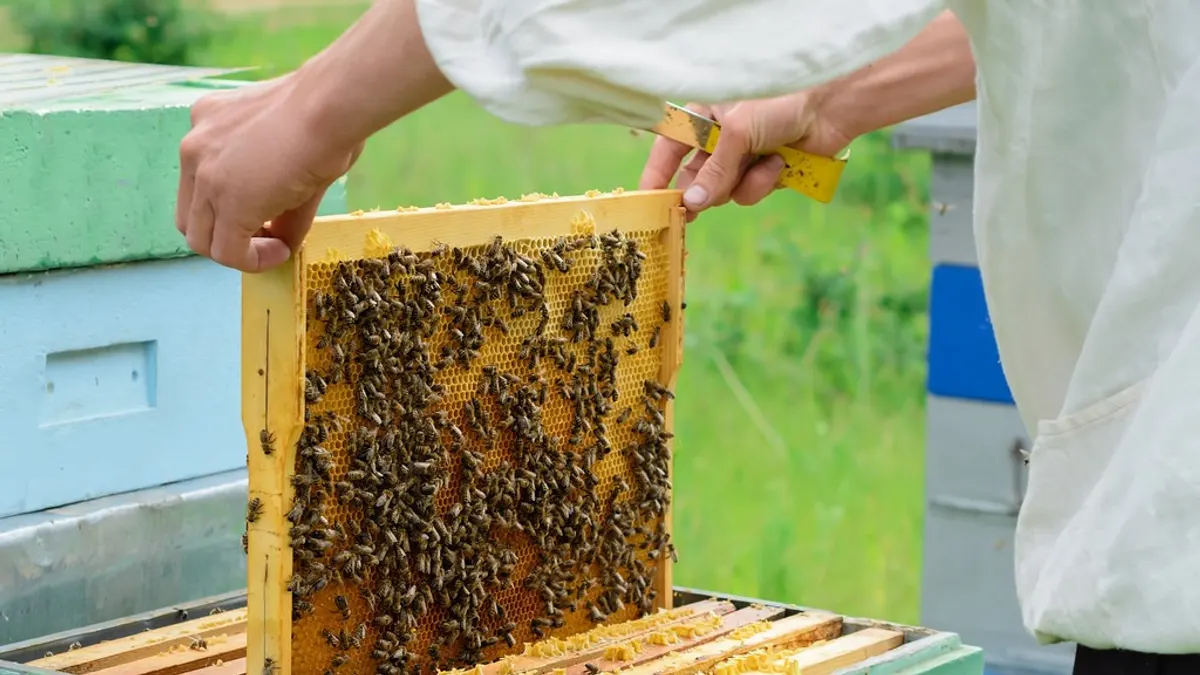
How to Inspect a Beehive Step by Step (and What to Look For)
Affiliate disclosure: product links on this page go to Amazon or to the maker's own store. As an Amazon Associate we earn from qualifying purchases, and VEVOR pays us a commission on sales through our VEVOR links, at no extra cost to you; links to other makers' stores earn us nothing. No retailer or brand sees our picks before they are published or has any say in them. How we choose.
To inspect a beehive, pick a calm day above 55°F, light your smoker, puff a little smoke into the entrance and under the lid, then take out the second frame from the side nearest you and work across the box one frame at a time, lifting each frame straight up. On every frame you are checking the same six things Utah State University Extension lists: brood, signs that the queen is laying, food, space, pests and disease, and the condition of the hive itself. Then put every frame back where it came from and write down what you saw.
You do not need to find the queen: eggs hatch about three days after they are laid, so a frame with eggs shows she was laying within the last three days. The steps below follow the Mid-Atlantic Apiculture Research and Extension Consortium (MAAREC), Utah State, the University of Tennessee and UF/IFAS, then cover reading the brood, swarm versus supersedure cells, the disease signs worth a call to your state apiary inspector, and how often to open the hive.
Before you open the hive
Decide what the visit is for and read your notes from last time. The University of Tennessee's inspection guide (W 1151) suggests settling the purpose first, so the hive is open only for a short time. Then pick the weather: Utah State says a calm day above 55°F, because cold or windy weather can chill or kill bees, and MAAREC suggests near midday in sun, avoiding late afternoon and approaching thunderstorms, when bees are more defensive.
Bring a veil (MAAREC's rule is every time), a lit smoker, a hive tool, a notebook and, when a count is due, a mite wash cup. A frame grip is optional. MAAREC suggests owning gloves, wearing them while you learn, and weaning yourself off them, because gloves stop you feeling a bee under your fingers before you crush it.
How to inspect a beehive, step by step
These steps follow MAAREC's handling method, with the checks from Utah State.
- Light the smoker and get thick, white, cool smoke before you walk over. Our guide on how to use a bee smoker covers fuel and lighting.
- Smoke the entrance. Approach from the side or rear and puff a little smoke into the entrance.
- Take off the top cover. Puff some smoke under it as you lift it, then set it upside down on the ground. It becomes the stand for any box you take off.
- Take off the inner cover. Pry up one corner with the hive tool (both corners if it is stuck), puff a little smoke under it, and stand it against the hive.
- Pull the second frame from the side nearest you. The outer frame may be stuck to the box with burr comb, and the second is the frame least likely to have the queen on it. Cut any burr comb, loosen both ends, and lever one end up with the hive tool, using the next frame as a fulcrum.
- Lift it straight up, slowly. Tilting or twisting rolls bees against the next comb, which crushes them, gets you stung and can kill the queen.
- Look at both sides. Turn the frame so the top bar is vertical, then spin it to see the other side. Utah State advises holding each frame over the open hive, so a bee that drops, the queen included, falls back in.
- Stand the first frame on its end against the hive. If it has brood on it and the day is cool, don't leave it out more than a minute or two.
- Work across the box. Slide the next frame into the gap, puff lightly across the top bars, lift, look and put it back against the outer side. Use a little smoke at each step; too much drives the bees off the frames you are trying to read.
- Going down a box. Pry the top box up with a puff of smoke between the boxes, lift it off and set it at an angle across the upturned cover so only its edges touch. MAAREC warns that a box set on a flat surface crushes many bees.
- Close up in the same order. Return the frames to their original positions. To put a box back, puff smoke under it, touch one corner down first and ease it into place. Then replace the inner and outer covers.
- Write it down: the date, weather, brood pattern, food, space, mite check and any action you took (Utah State's list).
What to check on each frame
Utah State's checklist has six items; the University of Tennessee groups the same ground into three (queen status and population, food stores, disease and pests). This table combines them.
| Check | What normal looks like | Warning signs |
|---|---|---|
| Brood and queen | Eggs, young larvae and capped brood in a steady patch | No eggs or young larvae; many empty cells scattered through the capped brood |
| Food | A ring of pollen around the brood; nectar and honey at the edges and in the outer frames | Very light stores; pollen or nectar packed into cells inside the brood nest |
| Space | Open cells for the queen to lay in, and room to store food | No empty comb left; a crowded hive is more likely to swarm |
| Queen cells | A few empty queen cups, which are normal | Queen cells with larvae in them (see below) |
| Varroa mites | A wash count under 2 to 3 mites per 100 bees (HBHC, most of the season) | Bees with deformed wings; mites you can see on adult bees, which the University of Tennessee says means a heavy infestation |
| Brood disease | Pearly white larvae with a wet, shiny look; tan or light brown caps | Sunken, dark or perforated caps; larvae that are brown, dry, melted or twisted |
| Pests | None in the comb | Small hive beetle larvae (cream-colored grubs) or wax moth larvae in the comb |
| Hive condition | Boxes and cover secure, dry inside, entrance clear | Damage from wind, water or animals |
How to read the brood
Utah State says you do not need to see the queen on every visit, because eggs and a steady brood pattern show that she is laying. Eggs are white, about the size and shape of a tiny grain of rice, one at the bottom of each cell. They are hard to see, so hold the frame with the sun or a bright light over your shoulder so the light reaches the bottom of the cells.
| Stage | What you see | Days since the egg was laid |
|---|---|---|
| Egg | A tiny white egg at the bottom of an open cell; it stands upright, then leans over | 1 to 3 |
| Larva | A white grub in an open cell, from a small comma to a C shape | About 4 to 8 |
| Capped brood | Tan or light brown wax caps over the developing bee | About 9 to 20 |
| Adult worker | The bee chews through the cap and comes out | Around 21 |
So the youngest brood you can find dates the queen's last laying. Eggs mean she laid within the last three days. Young larvae but no eggs means roughly four to eight days ago. Only capped brood means no eggs for at least eight days: the queen may be gone, or a new queen may not have started laying yet. That is a reading of the timeline, not a test, and Utah State's advice when eggs are missing is to check again soon and not to replace the queen because of one odd-looking frame. When a new queen is needed, our guide to buying a queen bee covers sellers, prices and introduction.
A good pattern is a solid patch with few empty cells; Utah State flags many empty cells as a warning sign when the colony should be growing. The University of Tennessee adds that pollen stored inside the brood nest means the colony needs more room, and that doing nothing leads to swarming or a colony that fails to build up. When you do want to see the queen herself, our guide to finding and marking the queen covers where she usually is.
Queen cells: swarm or supersedure?
Empty queen cups are common and are not a sign of swarming on their own, according to UF/IFAS (ENY-160). A cup becomes a queen cell once it holds an egg and the workers start extending it, and the cell is capped about eight days later. Once the cells are capped, UF says, it is difficult to stop the colony from swarming.
- Swarm cells: several cells along the bottom or outer edges of frames, with larvae being actively fed, in a colony that still has its queen.
- Supersedure cells: built when the queen dies or begins to fail, usually at the edge of the brood pattern or within it, where the youngest larvae are.
Location is a guide, not a rule, and UF notes exceptions both ways. Bees also hide queen cells, so in swarm season UF advises shaking the bees off each brood frame over the hive, with one to three quick shakes, before you look. Queen cells that are open at the bottom with ragged edges mean queens have already emerged, and the University of Tennessee says the old queen has likely left with a swarm.
Mites and brood disease
You cannot judge varroa by eye. The University of Tennessee says visual inspection for mites is not reliable or recommended: mites sit inside brood cells and on the underside of bees while you are looking at their backs, so the count comes out low and treatment comes late. Do a wash or a sugar roll instead. The Honey Bee Health Coalition (HBHC) method uses about 300 bees, roughly half a cup lightly packed, from one to three brood-nest frames, avoiding the queen. Our mite monitoring guide covers the count, the thresholds by season and the label treatments.
Look closely at any brood that doesn't match the healthy description above. These field signs come from the HBHC's foulbrood guide (second edition, November 2022) and Penn State Extension's quick reference guide:
| What you see | Possible cause | Source |
|---|---|---|
| Sunken, perforated, greasy-looking caps; coffee-brown to dark brown larvae; a dark scale stuck tight to the lower cell wall; a matchstick draws the contents out in a rope more than an inch (2 cm) long | American foulbrood (AFB) | HBHC |
| Larvae twisted in the cell, yellowish, gray or brown, looking melted; a rubbery scale that comes out easily; no smell or a mildly sour one | European foulbrood (EFB) | HBHC |
| Chalk-like mummies in the cells | Chalkbrood | HBHC |
| Sunken, snot-like larvae, workers with deformed wings and a high mite count | Parasitic mite syndrome (varroa) | Penn State Extension; HBHC |
If you suspect AFB, get it confirmed. The HBHC says to use more than one method and, if you are not confident, to have the colony examined by a state apiary inspector or extension specialist. AFB is a reportable disease in some states, its spores survive in equipment and honey for decades, and antibiotics do not treat it, so keep frames and honey from a suspect hive out of your other hives. Our beehive registration laws by state page links each state's apiary program.
The USDA's Bee Research Laboratory in Beltsville, Maryland, also diagnoses samples from US beekeepers at no charge. It asks for at least 100 adult bees in alcohol (pour off the excess before mailing), or a piece of brood comb at least 2 by 2 inches with no honey in it, wrapped in paper rather than plastic or foil. Its sample page has the current address.
How often to inspect a beehive
| When | How often | Main job |
|---|---|---|
| New package, day 3 or 4 | One short check | Make sure the queen has left her cage |
| New package, 7 to 10 days after that | One check | Look for eggs |
| Swarm season (spring, before and during the main nectar flow) | Weekly | Queen cells and space |
| Rest of the active season | Every 10 days to 3 weeks (Utah State's short answer: about every two weeks) | Brood, food, space, mites |
| Late fall | One last warm-weather check | Food, brood, disease signs, winter setup |
| Winter | No full inspections | Watch the entrance, clear snow, heft the hive; if you must lift the lid, pick a calm day above 55°F and work fast |
The weekly spring visits come from queen timing: the University of Tennessee notes that a new queen takes 16 days to develop and early queen cells are hard to see. UF/IFAS says to start watching for swarm signs two to four weeks before the main nectar flow. Between visits, Utah State says to go in early if you see a fast drop in activity in warm weather, many queen cells, very light stores, spotty brood, or signs of mites or disease. Our seasonal beekeeping calendar shows what each visit is for through the year, and the package and nuc installation guide covers a new colony's first checks.
Keep a record
The University of Tennessee's W 1151 ends with a one-page inspection sheet worth printing: queen seen and marked, eggs, larvae and pupae, brood pattern, stores, swarm potential, beetle and deformed-wing counts, the mite wash result and treatment dates. It also records the queen's mark, because an unmarked queen where a marked one used to be means she has been replaced. Read the last sheet before each visit so you bring what you need. Paper or a phone app both work; in UT's words, choosing between them matters less than choosing to keep records.
Tools that make an inspection easier
After the veil and smoker, the hive tool is the one thing you cannot do without, because propolis glues the covers, boxes and frames together. A J hook levers a frame end up against the next frame, the move MAAREC describes. The KINGLAKE J hook is 10-1/2 inches of 304 stainless steel (per the Amazon listing).
A frame grip clamps the top bar so you can lift a frame with one hand and keep the other free for the smoker. The WEICHUAN frame grip has stainless steel jaws and a beech handle (per the Amazon listing). Our hive tools and frame grips page compares six tools.
For the mite count, the Varroa EasyCheck is a wash cup with a filter basket and molded lines for 200 and 300 bee samples, and it works for an alcohol wash or a powdered sugar roll (per the Amazon listing).
Frequently asked questions
How often should you inspect a beehive?
Every 10 days to 3 weeks in the active season, according to Utah State University Extension, whose short answer is about every two weeks. Inspect weekly during swarm season in spring, because queen cells are easy to miss and a new queen takes only 16 days to develop. In winter, leave the hive closed except for a quick look on a calm day above 55°F.
What should you look for when inspecting a beehive?
Six things: eggs and brood, signs the queen is laying, food stores (pollen, nectar and capped honey), room to grow, pests and disease, and the condition of the boxes, cover and entrance. Do a mite wash on a schedule rather than looking for mites by eye, and write down what you find so you can compare visits.
Do you need to see the queen during a hive inspection?
No. Eggs hatch about three days after they are laid, so fresh eggs show the queen was laying within the last three days. If you find no eggs or young larvae, check again soon and look for queen cells or other signs of queen trouble before replacing her.
What temperature is too cold to inspect a beehive?
Utah State University Extension says to inspect on a calm day above 55°F, because cold or windy weather can chill or kill bees. On a cool day, MAAREC says not to leave a frame of brood out of the hive for more than a minute or two.
Which frame do you pull first when inspecting a hive?
The second frame from the side nearest you. The outer frame may be stuck to the box with burr comb, and the second frame is the one least likely to have the queen on it. The gap it leaves gives you room to move the other frames without crushing bees.
What time of day is best to inspect a beehive?
Near midday in sunny weather, according to MAAREC. Avoid late afternoon and approaching thunderstorms, when bees are more defensive.
What does a bad brood pattern look like?
Many empty cells scattered through a patch of capped brood, especially when the colony should be growing. Sunken, dark, greasy or perforated caps and larvae that are brown, dry, melted or twisted point to mites or brood disease; do a mite count and ask your state apiary inspector if you are unsure.
Sources
- Handling Bees, Mid-Atlantic Apiculture Research and Extension Consortium (MAAREC)
- What Should I Look for When Inspecting My Beehive?, Utah State University Extension
- How Often Should I Inspect My Beehive?, Utah State University Extension
- What Is Bee Brood?, Utah State University Extension
- Honey Bee Inspections and Recordkeeping (W 1151), University of Tennessee Extension (Jennifer Tsuruda)
- Swarm Control for Managed Beehives (ENY-160), UF/IFAS Extension
- Identifying and Mitigating Foulbrood in Honey Bee Colonies and Reducing the Use of Antibiotics, Second Edition, Honey Bee Health Coalition
- Tools for Varroa Management, 8th Edition, Honey Bee Health Coalition
- A Quick Reference Guide to Honey Bee Parasites, Pests, Predators, and Diseases, Penn State Extension
- How to Submit Samples (Bee Disease Diagnosis), USDA Agricultural Research Service, Bee Research Laboratory
Cover photo: bee keeping extension by Alachua County, Public Domain Mark, via Flickr. Cropped.
Related guides
How to Start Beekeeping: The First-Year Steps in Order
Start in the fall, not in spring: check the rules, order bees by January, learn and set up two hives over the winter, install in spring, then feed, inspect every two weeks and watch for mites.
Best Beekeeping Books of 2026: What Bee Courses Actually Assign
Six books from the Rutgers, EAS and UGA reading lists, by stage: first read, first seasons, master beekeeper study, the reference shelf and bee biology, plus the free guides.
Beehive Insulation and Winter Wraps: What Works and When (2026)
What a 43-hive trial found about wrapping, which wraps and top insulation to use, how to keep condensation off the cluster, and when to wrap and unwrap.