
Beehive Insulation and Winter Wraps: What Works and When (2026)
Affiliate disclosure: product links on this page go to Amazon or to the maker's own store. As an Amazon Associate we earn from qualifying purchases, and VEVOR pays us a commission on sales through our VEVOR links, at no extra cost to you; links to other makers' stores earn us nothing. No retailer or brand sees our picks before they are published or has any say in them. How we choose.
Beehive insulation pays off where winters are cold, and both the research and the extension advice put most of it on top of the hive. In a University of Illinois trial over the 2020 to 2021 winter, 43 hives were split in two: half got a black corrugated plastic wrap plus a 1.5-inch foam board (R-7.5) on the inner cover, half got nothing. One wrapped colony died, against six of the unwrapped ones, and the unwrapped hives burned through their stores almost twice as fast. For a ready-made wrap, the Bee Cozy, an R8 insulated sleeve for two 10-frame deep boxes, is sold both by its maker, NOD Apiary Products, and by Mann Lake.
Insulation is only half of winter prep. Bees give off water as they burn honey, and Cornell's overwintering guide warns that it condenses under the cover and drips back on the cluster: "Wet bees in cold weather will soon be dead bees." So every setup below keeps a small upper vent, an open lower entrance and an insulating or absorbent layer above the inner cover. And if you keep bees somewhere warm like Florida, Mann Lake says you will not need to winterize at all.
What bees do in winter, and why colonies die
Honey bees do not hibernate. In late summer the colony raises winter bees, which Penn State Extension says live up to six months, against six weeks for a summer bee, and carry larger fat bodies to get through the cold. In fall the workers drag the drones out. Once cold weather arrives, the bees form a cluster across several frames, warmest at the center, and make heat by vibrating their flight muscles, with honey as the fuel.
Bees heat the cluster, not the hive: Cornell's guide says drafts through gaps between boxes can drain that heat and kill the bees. The cluster eats only the honey it touches and moves to new stores when the weather allows. Brood rearing restarts around mid-February in the Northeast, and food use climbs with it.
So, do bees die in the winter? The summer bees do, and the colony is meant to come through as a cluster of winter bees around the queen. Many colonies still fail. US operations with five or more colonies lost 454,890 colonies, or 16%, from January to March 2026, according to USDA (our colony loss tracker has every quarter since 2015). Penn State says winter bees sick from mites and viruses die before spring and leave a cluster too small to survive; Cornell shows the other common end, a colony that climbed to the top of the hive and ran out of honey. Insulation fixes neither. It lowers the fuel bill of a colony with its mites under control and enough stores.
What the research says about insulating a hive
Modern evidence is thin: the Illinois authors note that most of the data behind hive covers sits in trade journals and is more than 40 years old. Three lines of work matter.
| Study | Setup | What it found |
|---|---|---|
| St. Clair, Beach and Dolezal, University of Illinois (PLOS ONE, 2022) | 43 colonies in 8 apiaries in central Illinois, winter 2020 to 2021. Half covered with a 4 mm black corrugated polypropylene sleeve and 1.5-inch Foamular 250 foam board (R-7.5) on the inner cover, with a top entrance cut in the wrap | 1 covered colony died, against 6 uncovered. Uncovered colonies lost weight almost twice as fast and ate more of a February sugar cake. Average cluster temperature did not differ |
| Alburaki and Corona, USDA-ARS Beltsville, Maryland (Journal of Apicultural Research, 2021) | 18 colonies: 9 in polyurethane hives, 9 in wooden Langstroth hives, each with a temperature and humidity sensor | Polyurethane hives averaged 10.20°C inside against 9.73°C for wood, at 52.05% relative humidity against 62.50%. Temperatures in the wooden hives swung more. The study measured conditions, not survival |
| Derek Mitchell, University of Leeds (papers from 2016 and 2023) | Heat-transfer analysis of hives and tree cavities | Common hives lose heat up to seven times faster than the tree hollows bees prefer, whose walls run around 150 mm (6 inches) against 19 mm (3/4 inch) for a wooden box. Mitchell argues the tight winter cluster is a stress response |
Two details of the Illinois result matter. Wrapped and unwrapped colonies kept the same average cluster temperature, so the wrap saved fuel rather than adding warmth, and the savings began in late February, once brood rearing started, not in the coldest weeks. That is the case for leaving wraps on into spring. Every colony was also treated for mites, weighed in above the researchers' 30 kg (66 lb) stores threshold and had an entrance reducer and a mouse guard: the wrap was added to good fall management, not used in place of it. The authors did no cost analysis.
Wraps and insulation compared
Prices are from each seller's own page on October 30, 2026; Amazon listings are linked without prices. Insulation figures are the maker's own.
| Option | What it is | Insulation figure | Fits | Price |
|---|---|---|---|---|
| Bee Cozy Winter Wrap (NOD Apiary Products) | Black UV-treated polypropylene sleeve filled with fiberglass | R8 | Two 10-frame deep boxes; single-deep and 8-frame versions exist | $43.99 at Mann Lake; $38.99 for the single-deep size |
| Mann Lake Easy On Hive Cover | Marine-grade vinyl over foam board with Velcro closures; sits under the lid so the entrance and top vent stay open | R-5 | Two 10-frame deeps (9 5/8 inch) | $53.99, Mann Lake only |
| Foam board on the inner cover | The Illinois setup: 1.5-inch Owens Corning Foamular 250 under the outer cover | R-7.5 | Cut to the hive's footprint | Home-improvement store item |
| Quilt box (BeeCastle shown) | Beeswax-coated fir box with a metal mesh floor that holds wood shavings, four screened vent holes (per the Amazon listing) | None published | 10-frame Langstroth | See the listing |
| Mann Lake Moisture Board | Half-inch board that wicks condensation; goes on top of the inner cover, under a wrap | None published | 10-frame | $15.99, Mann Lake only |
| MayBee winter hive wrap | 600D Oxford cloth over 3 mm "pearl cotton" padding and two foil layers, with Velcro and buckle straps (per the Amazon listing) | None published | 8- or 10-frame, two deeps (76.8 by 18.1 inches) | See the listing |
| Roofing (tar) paper | Wrapped around the boxes with at least an 8-inch overlap, stapled and tied with twine (Cornell's method) | None; a windbreak | Any hive | Hardware-store roll |
The Bee Cozy is the closest bought match for the Illinois wrap, with much more insulation in the sleeve itself: the trial's wrap was 4 mm corrugated plastic, and all of its insulation value sat in the foam on top. NOD says the wrap and its top insulation leave the top entrance clear, and its instructions call for both a top and a bottom entrance. Pair it with foam board or NOD's Bee Cozy Inner Cover Pad, which goes inside a deep inner cover or a shallow super.
For 8-frame boxes there is an 8-frame two-story Bee Cozy. The cheaper Oxford-cloth wraps on Amazon, MayBee's among them, publish no R-value, so treat them as wind and rain covers. Mann Lake's Easy On cover leaves the top vent open by design but sells only from Mann Lake. A polystyrene hive body insulates by itself; the wood and coating guide has the R-values.
A quilt box does a different job. It sits above the top box under the outer cover and holds wood shavings on a screen, which take up moisture before it can drip on the cluster. Cornell's homemade version is a spare shallow super holding a burlap "pillow" of shavings.
Moisture: keep it moving, keep it off the bees
As the cluster burns honey it gives off carbon dioxide and water. Cornell's guide says the carbon dioxide clears easily, but the water condenses on the coldest surface, usually the underside of the cover, and drips back onto the bees. Its fix is a small upper entrance as well as the lower one: a shim under the inner cover or a notch cut in it. The upper hole doubles as an exit for cleansing flights when snow or dead bees block the bottom. Face both entrances away from the prevailing wind.
Then put something above the inner cover. If your outer cover is not insulated, Cornell suggests a moisture-absorbent insulating layer, anything from a sheaf of straw to a box of wood shavings, as long as it does not block the upper entrance. NOD's Bee Cozy instructions add two steps: shim the back of the hive so it tips slightly forward and water runs out the entrance, and lay newspaper or another absorbent material under the inner cover pad.
Some beekeepers run a "condensing hive" instead: heavy top insulation (NOD cites R-5 to R-10 as a minimum) and only a lower entrance, so water condenses on the colder walls rather than over the cluster. NOD says much more research is needed. Cornell and the Illinois trial both kept an upper vent, so that is the tested setup for a first winter.
When to wrap and when to unwrap
- Finish the inspections first. Cornell says to do fall management while days are still above 50°F (10°C), because opening a colony in the cold is "at best stressful, and at worst, lethal."
- Wrap when the cold settles in. NOD says to put the Bee Cozy on once temperatures stay below 50°F, the point where bees cluster. Mann Lake's page says to wrap before temperatures dip below 45°F (7°C). The Illinois team wrapped on November 12.
- Check food from the top in late winter. Cornell suggests lifting the outer cover on a day that reaches 40°F in late February or early March. Bees up at the inner cover hole are running short. Penn State notes that bees cannot take cold syrup, so give fondant or hard sugar over the top bars.
- Clear the lower entrance about once a month with a thin stick, without knocking on the hive (Cornell). Snow over the entrance is no cause for worry, since air moves through it.
- Unwrap late. NOD's rule is to take the wrap off once temperatures stay above 50°F and snap freezes have passed. The Illinois savings came in late February and March.
Do you need to wrap at all?
Early 20th-century manuals told beekeepers north of 42°N (roughly Chicago and Boston) to winter bees indoors or wrapped. Farrar's experiments in Wisconsin in the 1940s showed clusters can manage outdoors without wraps, and the advice softened (both per the Illinois paper). The 2022 trial, at about 40°N, still found a benefit.
- Cold winters: Cornell's guide is written for places where November to March runs to average highs of 35°F and lows of 18°F. Wrap, insulate the top and keep the upper vent.
- Old or drafty boxes anywhere it freezes: wrap. Cornell says gaps between warped boxes mean you will have to wrap, and that a wrap still helps a tight hive.
- Warm, mild winters like Florida's: Mann Lake says no winterizing is needed, and that in mild winters the problem is moisture more than cold, so keep the ventilation and the stores.
Winter prep checklist
- Test and treat for varroa in late summer, while the colony raises its winter bees. Cornell says a first treatment in September or October is already too late. Our varroa treatment comparison covers the label rules.
- Check stores. Cornell's minimum is 80 pounds of honey for a two-deep hive and 50 for a nuc. Feed 2:1 syrup before the bees cluster, not 1:1 in fall (the syrup calculator does the mixing math).
- Combine weak or light colonies (Penn State).
- Fit an entrance reducer and a mouse guard, and add an upper vent.
- Put foam board, a quilt box or a moisture board above the inner cover, then wrap once days stay below 50°F.
- Strap the hive down behind a windbreak; Cornell says one that is 40 to 60% solid protects best.
- From late February, check food from the top. The seasonal calendar has the rest of the year.
Frequently asked questions
Should I insulate my beehive for winter?
Where winters freeze, yes: insulate the top and wrap the boxes, and keep a small upper vent. In a University of Illinois trial of 43 hives, colonies with a plastic wrap and R-7.5 foam on the inner cover ate less of their stores and only one died, against six uncovered. In warm areas like Florida, Mann Lake says winterizing is not needed.
Do bees die in the winter?
The summer workers die off, but the colony is meant to survive as a cluster of long-lived winter bees around the queen; Penn State says winter bees live up to six months. Many colonies still die. US operations with five or more colonies lost 454,890 colonies, or 16%, from January to March 2026, according to USDA. Mites, starvation and wet clusters are the main threats in the extension guides.
What do bees do in the winter?
They form a cluster across several frames, warmest in the middle, and vibrate their flight muscles to make heat, burning stored honey. The cluster moves up and across the combs to reach food when it is warm enough to move, and bees leave on mild days for cleansing flights. The queen starts laying again in late winter, around mid-February in the Northeast.
When should I wrap my beehive for winter?
NOD Apiary Products, which makes the Bee Cozy, says to wrap once temperatures stay below 50°F (10°C) and to unwrap once they stay above 50°F and snap freezes have passed. Mann Lake says to put wraps on before temperatures dip below 45°F. Do any inspections first, while days are still above 50°F.
Does wrapping a beehive cause condensation?
Not if the hive can still breathe. Cornell's tar paper method cuts the paper open at the upper entrance and keeps the lower entrance clear, NOD says its wrap needs both a top and a bottom entrance, and Mann Lake's Easy On cover sits under the lid to leave the top vent open. Cornell's fix for condensation is that upper vent plus an absorbent or insulating layer above the inner cover.
Is a quilt box better than foam board?
They do different jobs. Foam board adds insulation (the 1.5-inch Foamular 250 used in the Illinois trial is rated R-7.5), while a quilt box holds wood shavings that soak up moisture and has no published R-value. Cornell recommends a moisture-absorbent insulating layer when the outer cover is not insulated. The tested Illinois setup was foam plus an upper vent.
Can I use tar paper instead of a hive wrap?
Yes. Cornell describes wrapping the boxes in roofing paper with at least an 8-inch overlap, stapled at the seams and corners, tied with twine, trimmed to fit under the outer cover and cut open at the upper entrance. The Illinois researchers describe tar paper as a windbreak wrap, so add foam board or a quilt box on top for insulation.
Sources
- Overwintering, Cornell CALS Pollinator Network
- Honey bee hive covers reduce food consumption and colony mortality during overwintering, PLOS ONE (University of Illinois Urbana-Champaign)
- Honey Bee Management Throughout the Seasons, Penn State Extension
- Polyurethane honey bee hives provide better winter insulation than wooden hives, Journal of Apicultural Research
- Research challenges beliefs on honeybee insulation, University of Leeds
- Honey Bee Colonies (August 3, 2026), USDA National Agricultural Statistics Service
- BEE COZY Winter Hive Wrap, NOD Apiary Products
- Why Wrap Your Beehives and When to Unwrap in Spring, NOD Apiary Products
- Bee Cozy Winter Wraps, Mann Lake
- Winterizing and Insulating Your Hive, Mann Lake
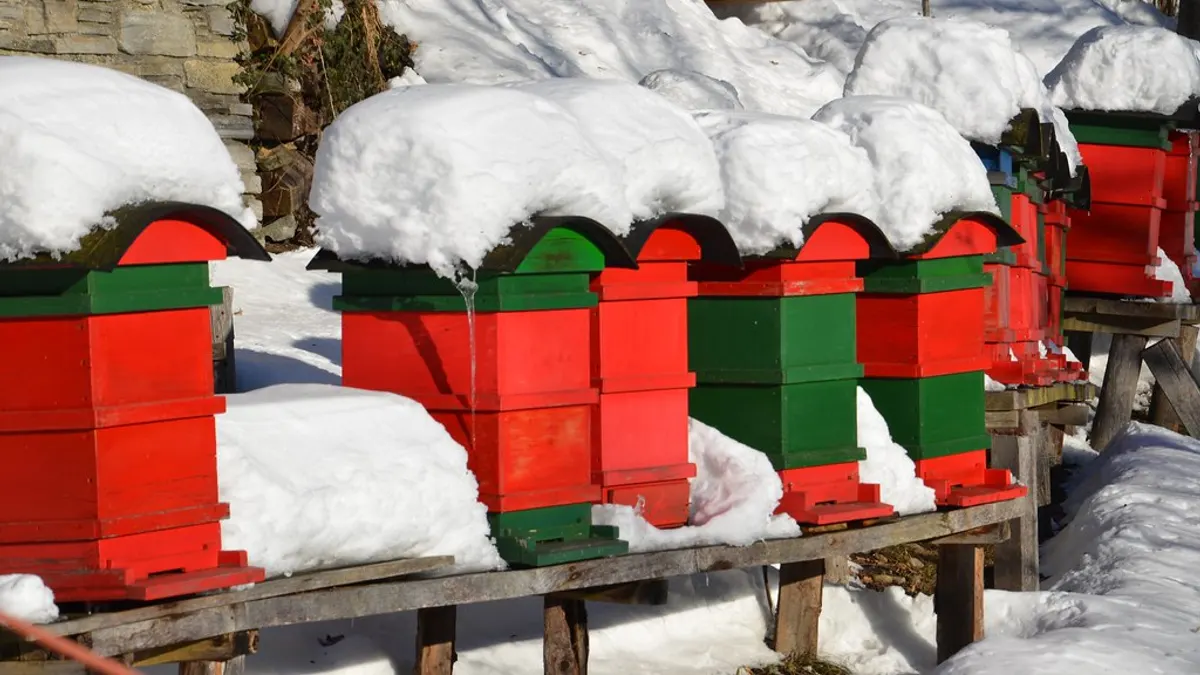
Cover photo: Bienenstoecke im Schnee by margit.winkler, CC0 1.0, via Flickr. Cropped.
Related guides
How to Start Beekeeping: The First-Year Steps in Order
Start in the fall, not in spring: check the rules, order bees by January, learn and set up two hives over the winter, install in spring, then feed, inspect every two weeks and watch for mites.
Best Beekeeping Books of 2026: What Bee Courses Actually Assign
Six books from the Rutgers, EAS and UGA reading lists, by stage: first read, first seasons, master beekeeper study, the reference shelf and bee biology, plus the free guides.
Where to Buy a Queen Bee: Breeders, Prices and Shipping (2026)
Breeders, supply companies or a local beekeeper: 2026 queen prices, when to order, how queens ship, what the guarantees cover and how to introduce her.