
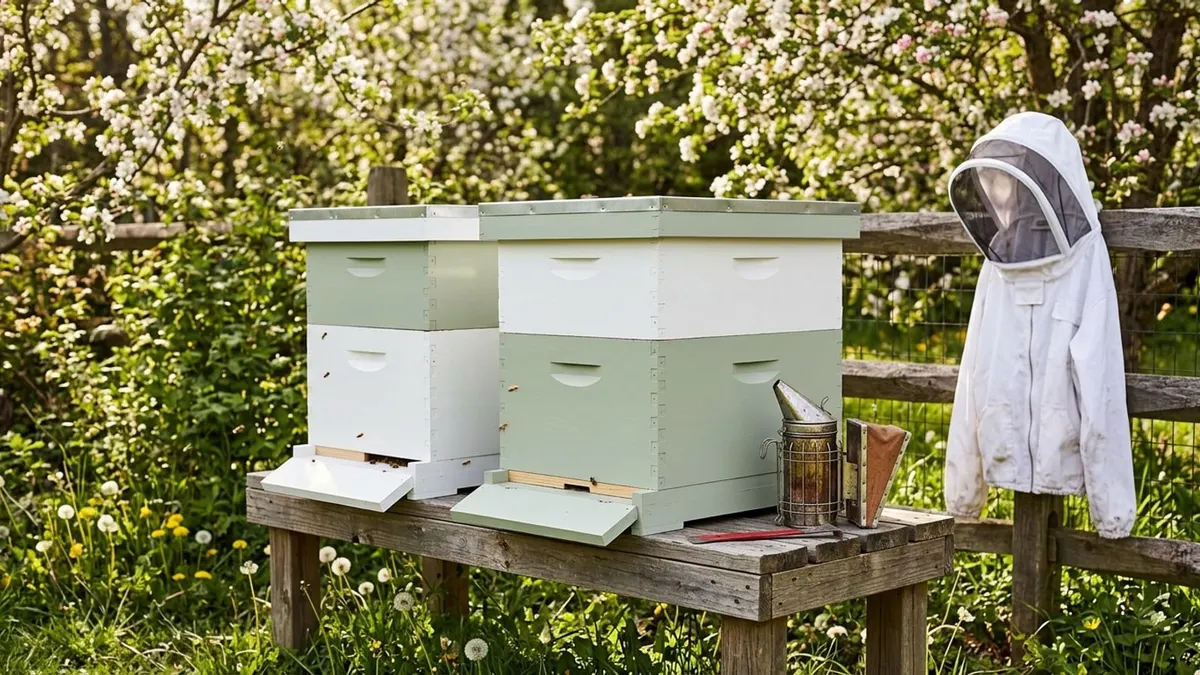
How to Start Beekeeping: The First-Year Steps in Order
Affiliate disclosure: product links on this page go to Amazon or to the maker's own store. As an Amazon Associate we earn from qualifying purchases, and VEVOR pays us a commission on sales through our VEVOR links, at no extra cost to you; links to other makers' stores earn us nothing. No retailer or brand sees our picks before they are published or has any say in them. How we choose.
To start beekeeping, work back from spring. The extension guides agree on the order: make sure you can keep bees (allergy, local rules, neighbors), order bees by early January at the latest, learn over the winter, have equipment for two hives assembled before the bees arrive, install them in spring, then spend the first season feeding, inspecting every two weeks and checking for mites. Alabama Extension puts the first-year budget at about $1,000 at a bare minimum and the time at 30 to 50 hours a year.
November is not too early. Penn State Extension says packages and nucs should be ordered the fall before the spring you need them, and Mississippi State says preparation should begin no later than the autumn or winter before. Below are the steps in order, with the season each belongs to and what to buy for each.
The first year, step by step
Dates shift with latitude. Mississippi State puts the best start in Mississippi at the end of March through early May; Utah State says bees there usually arrive in March or April. The order stays the same.
| Step | When | What to do |
|---|---|---|
| 1. Check you can keep bees | Fall | Allergy, state registration, town and HOA rules, neighbors, budget |
| 2. Order bees | Fall to early January | Two packages or two nucs, with a pickup or shipping date |
| 3. Learn | Winter | Local club, a mentor, a course, the standard books |
| 4. Buy and assemble equipment | Winter | Woodenware for two hives, protective gear, smoker, hive tool, feeders, stand |
| 5. Set up the site | Before the bees arrive | Stand in place, entrance facing south or southeast; electric fence first where bears live |
| 6. Install the bees | Spring | A calm, sunny day above 55°F; with a package, check the queen is out of her cage in 3 to 4 days |
| 7. Feed and add boxes | First two months | Syrup refilled every 4 to 5 days; a new box as each one fills with comb |
| 8. Inspect | Spring and early summer | Every two weeks, about 45 minutes per colony |
| 9. Control mites | From midsummer | Sample, and treat by the label when counts call for it |
| 10. Prepare for winter | Late summer and fall | Monthly checks, enough honey stored, syrup for a light colony |
Step 1: Make sure you can keep bees
Allergy. Most people get a local reaction to a sting: swelling, redness and itching that usually fade within 24 hours. Alabama Extension says anyone who has had a reaction spread beyond the sting site may want to see an allergist before keeping bees, and advises against beekeeping after an anaphylactic reaction. If you know you are allergic, talk to a doctor first.
Rules. Some states require you to register hives with the state department of agriculture, and some towns and homeowners associations restrict backyard bees. Check your state in our beehive registration rules for all 50 states, then your town and HOA. Alabama Extension also says to tell your neighbors, and to ask whether anyone has had a severe reaction to a sting.
Money, time and losses. Alabama Extension estimates about $350 per colony for bees, two brood boxes and the parts that go with them, and recommends two colonies. Its 2025 price list for two package colonies plus a jacket, gloves, hive tool and smoker came to $836, before feeders, sugar and mite treatments. Our startup cost calculator fills in the rest. Budget the time too (30 to 50 hours a year, mostly in spring), and expect losses: the same guide estimates US beekeepers lost an average of 45 percent of their colonies a year over the last five years.
Step 2: Order bees early
Penn State says to order packages and nucs the fall before you need them. Mississippi State says suppliers build their customer lists in the autumn or just after January 1, and that ordering in spring usually means getting bees very late. Utah State says orders there typically open in January for March or April delivery.
| Package | Nuc (nucleus colony) | |
|---|---|---|
| What arrives | 2, 3 or 5 lb of bees in a screened box, a caged queen, a syrup can | 4 or 5 frames of comb with brood, honey, pollen, bees and a laying queen |
| The queen | Cannot be judged yet (no brood) | Her brood pattern is already on the frames |
| Feeding | Must be fed until the nectar flow | Fed less heavily: it arrives with food and comb |
| Honey in year one | Little chance | Possible with a strong nectar flow |
| Price | The cheapest start | More than a package, less than an established colony |
Penn State calls the 3-pound package often the best buy; Oregon State's extension pollinator specialist tells beginners to ask a local supplier for a nuc. Either way, get two. Penn State advises starting with at least two or three colonies, since two take no more time to manage than one, and the University of Georgia notes that with two you can move frames of brood and honey to boost a weaker colony. More in how many hives to start with, and on suppliers in where to buy bees and equipment.
Step 3: Learn over the winter
Alabama Extension's advice to anyone set on starting is to find a local beekeeping club, go to local and statewide meetings, and find a mentor. Penn State says most states and many counties have a beekeepers' association, and your county extension office can name yours. For a course, Alabama Extension runs a free online course, Beekeeping Basics, and Penn State sells an online Beekeeping 101 course ($159 on its site in November 2026).
Step 4: Buy and assemble the equipment
Mississippi State's winter list for a first-year beekeeper is protective gear, woodenware that is bought, assembled and weatherproofed before the bees come, and as much reading as you can do. For two hives:
| Item | For two hives | Note |
|---|---|---|
| Bottom boards, inner covers, lids | 2 of each | A telescoping lid over an inner cover insulates the top |
| Hive boxes | At least 4 deeps (2 per hive) | Alabama Extension's count; Mississippi State says to have 2 to 3 boxes per hive ready to add as the colony grows |
| Frames and foundation | A set for every box | Deep frames in deep boxes, medium in medium; never mix |
| Feeders | 2 | Mississippi State uses a 1-gallon division board (frame) feeder |
| Entrance reducers | 2 | On Utah State's install-day list |
| Stand or cinder blocks | Room for both hives | Lifts the hive 12 to 18 inches (Utah State) |
| Veil, jacket or suit, gloves | 1 set | Mississippi State: a veil is highly recommended for new beekeepers |
| Smoker, hive tool, bee brush | 1 each | Smoker and hive tool on Alabama Extension's list, bee brush on Utah State's |
A kit covers the woodenware for one hive. The Hoover Hives Gold Standard 10-frame kit, the woodenware pick in our beehive starter kit guide, comes with two beeswax-dipped deep boxes with 20 frames, a medium super with 10 frames, a solid bottom board, inner and telescoping covers, a queen excluder, an entrance reducer and a mouse guard, per Hoover Hives' parts list. It has no feeder, tools or gear, so two kits plus those items make a two-hive start.
For yourself, light clothing helps: Mississippi State says dark colors and sharp color contrasts draw the most stings, and white coveralls cut them. The USKeepers three-layer ventilated jacket, our top jacket pick, comes with two veils and gloves (per the Amazon listing).
Step 5: Pick the spot
Utah State's placement rules: face the entrance south or southeast so the hive gets 6 to 8 hours of direct sun from early morning, keep 10 to 15 feet clear in front for the flight path, raise the hive 12 to 18 inches, and weigh down or strap the lid against raccoons and wind. Alabama Extension adds water and flowers within reach all year, and an easy walk in for you. Mississippi State suggests shrubs or a privacy fence to push flight paths above the neighbors' heads. Where bears live, Penn State recommends an electric fence around the apiary before the bees arrive.
Step 6: Install the bees
Pick a sunny, calm day above 55°F (Utah State). Mississippi State says package bees survive best when installed within 1 to 2 days of arrival, kept somewhere cool and dark until then, and never left in a parked car without air conditioning. With a package, check that the queen has left her cage within 3 to 4 days. Our package and nuc installation guide has the full steps for both.
Step 7: The first season
Feed. A new colony has to build comb, and comb is made from sugar. Mississippi State feeds a 50 percent syrup (8 pounds of white sugar in a gallon of water) in a division board feeder, refilled every 4 to 5 days, and calls stopping once the first box is drawn "a big mistake." Stop when the bees stop taking syrup, or when syrup fills the cells the queen needs for eggs. Its target is two to three boxes of drawn comb before mid-July.
Inspect. Alabama Extension plans an inspection every two weeks in spring and early summer, about 45 minutes per colony, then once a month after the main nectar flow. Penn State gives the reason for the two-week rhythm: a new queen takes about 16 days from egg to adult, so a two-week check catches swarm preparations. See how to inspect a beehive for what to check on each frame.
Mites. Penn State says summer is the time to start monitoring for varroa, and that mites must be assessed and treated in late summer, while the colony raises its winter bees. Mississippi State now advises treating first-year colonies with a miticide from early to mid-July, by the label, so mite loads are low going into autumn. Compare sampling kits in our varroa mite monitoring kits guide.
Honey. Don't plan on any. Alabama Extension says most new colonies make no surplus honey in their first season, and Penn State gives a package little chance of a crop in year one. The first-year goal is a big colony with food for winter: Alabama Extension's rule for its state is at least 40 pounds of stored honey, with sugar syrup for a light colony.
When is the best time to start a beehive?
Spring, timed to the first strong bloom, which means the planning starts the fall before. Penn State says spring is the best time to establish new colonies, with Pennsylvania's nectar flows in May and June. Mississippi State's window is the end of March through early May, and it warns that colonies started after mid-May may need syrup to get through the summer dearth. Your local club will know the dates where you live.
Mistakes the extension guides warn about
- Starting with one hive. Alabama Extension says a second colony gives you something to compare against, and the University of Georgia notes you can move frames of brood and honey to boost a weaker one.
- Ordering bees in spring. Mississippi State says late orders usually mean late bees.
- Buying used equipment. Alabama Extension advises against it: old boxes and comb can carry American foulbrood and pesticide residues for decades.
- Mixing frame sizes. A frame too short for its box leaves a gap the bees fill with burr comb (Mississippi State).
- Feeding at the entrance. Mississippi State says syrup at the entrance draws robber bees from other hives; feed inside the hive.
- Skipping mite checks. Mississippi State warns that a fast-growing first-year colony can reach dangerous mite levels before the year is out, and high mite loads kill colonies over winter.
Frequently asked questions
How do I start beekeeping with no experience?
Join a local beekeeping club, find a mentor and take a course over the winter, and order bees by early January at the latest. Buy and assemble equipment for two hives before spring, install the bees on a calm day above 55°F, then feed and inspect every two weeks through the first season. Alabama Extension runs a free online course called Beekeeping Basics.
When is the best time to start a beehive?
Spring, timed to the first strong bloom: the end of March to early May in Mississippi, March or April deliveries in Utah, and nectar flows in May and June in Pennsylvania. Order bees the fall or early winter before, because suppliers fill their lists early.
How much does it cost to start beekeeping?
Alabama Extension puts a first-year budget at about $1,000 at a bare minimum, with about $350 per colony for bees, two brood boxes and their parts, and two colonies recommended. Its 2025 price list for two package colonies and basic protective gear came to $836 before feeders, sugar and mite treatments.
Should I start with one beehive or two?
Two. Penn State Extension recommends starting with at least two or three colonies because two take no more time to manage than one. The University of Georgia notes that with two you can move frames of brood and honey from a strong colony to a weaker one.
Should I buy a package of bees or a nuc?
A nuc arrives as 4 or 5 frames of comb with brood, food and a laying queen, so it builds faster and can make honey in year one if the nectar flow is strong. A package is loose bees and a caged queen; it costs less but must be fed until the nectar flow. Oregon State's extension pollinator specialist recommends a nuc for beginners.
Will I get honey the first year?
Usually not. Alabama Extension says most newly established colonies produce no surplus honey in their first season, and Penn State says package bees have little chance of a honey crop in year one. Leave the first year's honey for the bees to get through winter.
How much time does beekeeping take?
Alabama Extension estimates 30 to 50 hours a year. Spring is the busiest season, with an inspection every two weeks at about 45 minutes per colony; after the main nectar flow, once a month is enough, and winter needs few inspections.
Sources
- Beekeeping - Honey Bees, Penn State Extension
- Honey Bee Management Throughout the Seasons, Penn State Extension
- Beekeeping Basics: Is Beekeeping Right for You? (ANR-3239), Alabama Cooperative Extension System
- Beginning Beekeeping in Mississippi (Publication 3594), Mississippi State University Extension
- Setting Up and Placing a Hive, Utah State University Extension
- Buying and Moving Colonies (Beekeeping Resources), University of Georgia Honey Bee Program
- How do I source bees for a new beehive box?, Oregon State University Extension Service
- Hoover Hives Gold Standard 10-frame kit (figures from Hoover's own page; this link goes to the same kit at Galena Farms, which sells Hoover's hives), Hoover Hives
Cover image: Illustration: Beekeeping Gear Review (AI-generated)
Related guides
Best Beekeeping Books of 2026: What Bee Courses Actually Assign
Six books from the Rutgers, EAS and UGA reading lists, by stage: first read, first seasons, master beekeeper study, the reference shelf and bee biology, plus the free guides.
Beehive Insulation and Winter Wraps: What Works and When (2026)
What a 43-hive trial found about wrapping, which wraps and top insulation to use, how to keep condensation off the cluster, and when to wrap and unwrap.
Where to Buy a Queen Bee: Breeders, Prices and Shipping (2026)
Breeders, supply companies or a local beekeeper: 2026 queen prices, when to order, how queens ship, what the guarantees cover and how to introduce her.