
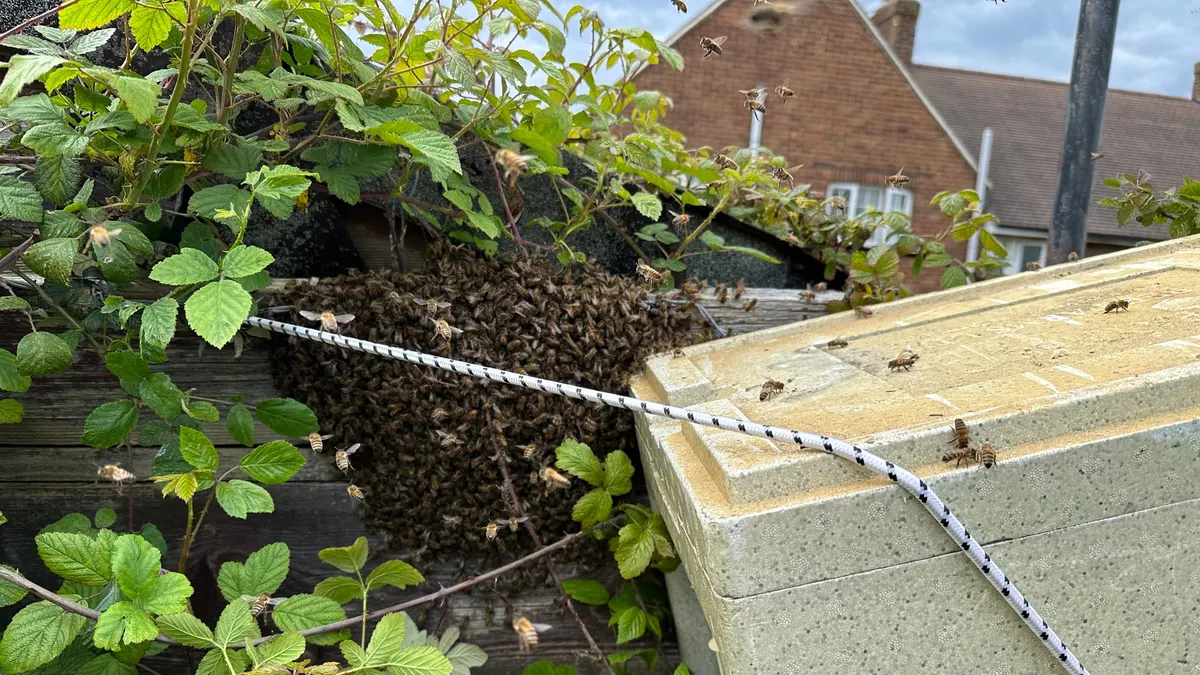
Best Swarm Traps of 2026: Bait Hives, Lures and Where to Hang Them
Affiliate disclosure: product links on this page go to Amazon or to the maker's own store. As an Amazon Associate we earn from qualifying purchases, and VEVOR pays us a commission on sales through our VEVOR links, at no extra cost to you; links to other makers' stores earn us nothing. No retailer or brand sees our picks before they are published or has any say in them. How we choose.
The best swarm trap for most backyard beekeepers is THE INTERCEPTOR PRO: it takes deep Langstroth frames, so a caught swarm moves into your hive frame by frame, it weighs under 6 pounds without frames, and a snap-in gate closes the entrance without tools (per the Amazon listing). Whatever trap you choose, the research behind it is Cornell's: swarms chose a cavity of about 40 liters (1.4 cubic feet, the volume of one 10-frame Langstroth deep) with an entrance of 1 1/2 to 2 square inches near the floor, hung about 15 feet up in shade.
The other picks: a Hoover Hives deep box finished as Cornell's own bait hive for the lowest cost, Blythewood's wood pulp trap as the cheapest ready-made trap, Little Larue Apiary's assembled wooden trap, and the Benefitbee kit, which ships with frames and states a 48-liter cavity. This guide is for beekeepers who want free bees in spring or want to catch their own swarms.
Our top picks at a glance
1. Best overall
THE INTERCEPTOR PRO Swarm Trap (no frames, unassembled)Type: Frame trap with snap-in closure gate (per listing) · Frames: Deep Langstroth, not included (complete kit adds them) · Size: 21 x 20.5 x 9.25 in outside (per listing) · Weight: Under 6 lb without frames (per listing)
2. Best value (Cornell's own design)
Hoover Hives Beeswax-Coated 10-Frame Deep Box (no frames)Type: 10-frame Langstroth deep box, beeswax coated (DIY bait hive) · Frames: Holds 10 deep frames, none included · Size: One 10-frame deep, about 40 L (Cornell) · Weight: Not listed
3. Best budget ready-made
Blythewood Bee Company Wood Pulp Swarm TrapType: Molded wood pulp pot with lid, no frames · Frames: None · Size: 15 x 17 x 21 in (per listing) · Weight: 5 lb (per listing)
4. Best assembled wooden trap
Little Larue Apiary 5-Frame Wooden Swarm Trap (assembled, with hanger)Type: Wooden 5-frame box, assembled, with tree hanger (per listing) · Frames: 5 deep Langstroth, not included · Size: 20 x 9.25 x 18 in outside (per listing) · Weight: Not listed
5. Best kit with frames included
Benefitbee H28 5-Frame Swarm Trap Kit (48 L, with frames)Type: 5-frame trap with sliding frame rails (per listing) · Frames: 5 one-piece plastic frames included · Size: 48 L cavity (per listing) · Weight: 9 lb with frames (per listing)
| Pick | Type | Frames | Size | Weight | Buy |
|---|---|---|---|---|---|
| THE INTERCEPTOR PRO Swarm Trap (no frames, unassembled)Best overall | Frame trap with snap-in closure gate (per listing) | Deep Langstroth, not included (complete kit adds them) | 21 x 20.5 x 9.25 in outside (per listing) | Under 6 lb without frames (per listing) | Amazon |
| Hoover Hives Beeswax-Coated 10-Frame Deep Box (no frames)Best value (Cornell's own design) | 10-frame Langstroth deep box, beeswax coated (DIY bait hive) | Holds 10 deep frames, none included | One 10-frame deep, about 40 L (Cornell) | Not listed | Amazon |
| Blythewood Bee Company Wood Pulp Swarm TrapBest budget ready-made | Molded wood pulp pot with lid, no frames | None | 15 x 17 x 21 in (per listing) | 5 lb (per listing) | Amazon |
| Little Larue Apiary 5-Frame Wooden Swarm Trap (assembled, with hanger)Best assembled wooden trap | Wooden 5-frame box, assembled, with tree hanger (per listing) | 5 deep Langstroth, not included | 20 x 9.25 x 18 in outside (per listing) | Not listed | Amazon |
| Benefitbee H28 5-Frame Swarm Trap Kit (48 L, with frames)Best kit with frames included | 5-frame trap with sliding frame rails (per listing) | 5 one-piece plastic frames included | 48 L cavity (per listing) | 9 lb with frames (per listing) | Amazon |
Best overall
THE INTERCEPTOR PRO Swarm Trap (no frames, unassembled)
A light, frame-ready trap with a tool-free closure gate and a tree strap, for beekeepers who want the swarm on Langstroth frames from day one.
- Type
- Frame trap with snap-in closure gate (per listing)
- Frames
- Deep Langstroth, not included (complete kit adds them)
- Size
- 21 x 20.5 x 9.25 in outside (per listing)
- Weight
- Under 6 lb without frames (per listing)
Pros
- Comb is built on frames, so the transfer is frame to frame
- Snap-in/snap-out gate closes the entrance with no tools (per the listing)
- Under 6 lb without frames, per the listing
- Tree strap and hooks included
Cons
- The listing gives no cavity volume or entrance size
- Frames cost extra unless you buy the complete kit
- Amazon listed it as low in stock on November 11, 2026
THE INTERCEPTOR PRO is sold on Amazon by its maker, unassembled (about 10 minutes to put together, per the listing), with a tree strap and hooks. It holds deep Langstroth frames, and Cornell's bait hive bulletin explains why that matters: comb built in wooden frames makes the transfer to a hive easy, while free comb has to be cut out and tied into frames.
The snap-in gate lets you shut the swarm in at dusk without a hammer or a screen. The complete kit arrives assembled with frames, foundation, a lure and a beeswax coating. Neither listing gives the cavity volume or entrance size, so you can't check it against Cornell's 40 liters. Skip it if you want to spend less: the next pick matches Cornell's volume for a fraction of the price.
Best value (Cornell's own design)
Hoover Hives Beeswax-Coated 10-Frame Deep Box (no frames)
The cheapest way to build Cornell's 40-liter bait hive: a 10-frame deep body with a plywood top and bottom and a 1 1/4-inch hole near the floor.
- Type
- 10-frame Langstroth deep box, beeswax coated (DIY bait hive)
- Frames
- Holds 10 deep frames, none included
- Size
- One 10-frame deep, about 40 L (Cornell)
- Weight
- Not listed
Pros
- Matches the cavity volume Cornell's swarms chose
- Frames you already own fit, so the transfer is frame to frame
- Goes back into service as an ordinary hive body after the season
Cons
- You add the top, bottom, entrance hole and hanger
- You must make it rainproof; Cornell and Lincoln University both stress a dry box
Cornell Information Bulletin 187, by Thomas Seeley, Roger Morse and Richard Nowogrodzki, recommends exactly this: nail a top and a bottom onto a standard Langstroth hive body, leaving the nail heads slightly proud so the top comes off later. One 10-frame deep holds about 1.4 cubic feet (40 liters). The Hoover Hives box is a beeswax-coated 10-frame deep sold without frames (per the Amazon listing).
To finish it, drill a round entrance about 1 1/4 inches (3.2 cm) across near the floor with a nail across it against birds, seal every crack against light and water (Cornell suggests duct tape), and fit a cleat or hanger. MAAREC sees no advantage in more than 3 to 5 frames in a bait hive; Cornell suggests a few wired frames, each holding a strip of foundation (see our frames and foundation guide).
Skip it if you have no drill. Old boxes with drawn comb smell more attractive to scouts, but MAAREC says to check them for American foulbrood first.
Best budget ready-made
Blythewood Bee Company Wood Pulp Swarm Trap
A light molded-pulp pot, the trap type UF/IFAS builds its trap lines around, for beekeepers who want several traps up for little money.
- Type
- Molded wood pulp pot with lid, no frames
- Frames
- None
- Size
- 15 x 17 x 21 in (per listing)
- Weight
- 5 lb (per listing)
Pros
- 5 lb, per the listing
- Water-resistant wood pulp, per the listing
- The trap type UF/IFAS describes for professional trap lines
Cons
- No frames: comb must be cut out and tied into frames
- No published volume; UF/IFAS describes these pots as 5 to 10 gallons
Pulp pots are what the University of Florida's swarm-trapping procedure (UF/IFAS ENY-148) is built around: 5- to 10-gallon fiber or pulp-paper pots with a lid, often treated with a fungicide against mold and rot. Blythewood's trap is water-resistant wood pulp, 15 by 17 by 21 inches and 5 pounds (per the Amazon listing). Mann Lake sells its own molded-fiber Bee Swarm Trap direct for $35.99 (November 11, 2026), lists the same size and weight, and says it lasts multiple swarm seasons.
The catch is the lack of frames. The bees build free comb in the pot, so at transfer you cut the combs out and tie brood comb into empty frames with cotton string (Cornell). Lincoln University advises moving the bees within about a week of noticing them. Skip it if you want the easiest transfer.
Best assembled wooden trap
Little Larue Apiary 5-Frame Wooden Swarm Trap (assembled, with hanger)
A pine box built to Langstroth frame size and sold assembled with a hanger, for beekeepers who want a wooden frame trap without building one.
- Type
- Wooden 5-frame box, assembled, with tree hanger (per listing)
- Frames
- 5 deep Langstroth, not included
- Size
- 20 x 9.25 x 18 in outside (per listing)
- Weight
- Not listed
Pros
- Arrives assembled with a tree hanger
- Standard frames, so the comb goes straight into your hive
- Built for reuse season after season, per the listing
Cons
- No published cavity volume or entrance size
- Frames not included
- Costs several times more than a deep box you finish yourself
Little Larue Apiary's trap is a pine box built to Langstroth dimensions with room for five frames, sold fully assembled with a tree hanger (per the Amazon listing). The listing gives outside measurements of 20 by 9.25 by 18 inches but no cavity volume or entrance size.
It suits a beekeeper who wants Cornell's approach, a wooden box with frames inside, without cutting plywood. Skip it if you own a drill: the Hoover deep box gets you Cornell's tested volume for much less.
Best kit with frames included
Benefitbee H28 5-Frame Swarm Trap Kit (48 L, with frames)
The only pick that states its cavity volume (48 liters) and ships with five frames, for beekeepers who want a trap that is ready the day it arrives.
- Type
- 5-frame trap with sliding frame rails (per listing)
- Frames
- 5 one-piece plastic frames included
- Size
- 48 L cavity (per listing)
- Weight
- 9 lb with frames (per listing)
Pros
- States a 48-liter cavity, close to Cornell's 40
- Rails adjust from 32 to 49 cm for Langstroth, Dadant, UK and National frames (per the listing)
- Stainless steel keel rated for more than 70 lb (per the listing)
Cons
- Entrance size not given
- Plastic frames need a beeswax coat before use (per the listing)
Benefitbee's H28 is the only trap here whose listing states a cavity volume: 48 liters, a little more than the 40 liters Cornell's swarms chose. The kit ships with five one-piece plastic frames, and the frame rails slide from 32 to 49 cm so the same box takes Langstroth, Dadant, UK or National frames (per the Amazon listing). The trap weighs 9 pounds with frames.
The listing says to coat the plastic frames with beeswax before use; Cornell found the smell of beeswax attractive to scouts. Benefitbee sells the same box without frames if you have your own. Skip it if you want a wooden box, or if a published entrance size matters to you.
How we chose
We judged every trap against Cornell Cooperative Extension's Bait Hives for Honey Bees (Information Bulletin 187), whose recommendations come from choice tests near Ithaca, New York, in which swarms picked between bait hives that differed in one respect at a time. The criteria: a cavity near 40 liters, a small entrance, frames, a dry lid and a sound way to hang it. Specs are from the maker or the Amazon listing, as marked; prices in the text are the maker's own on November 11, 2026, and buy boxes show Amazon's live price.
What swarms look for in a swarm trap
Cornell's bulletin turns its choice tests into 12 recommendations for a bait hive. Near Ithaca, its authors caught swarms in 80 percent of the bait hives they set out in good years and fewer than 20 percent in their poorest year.
| Factor | What swarms chose | What it means for a trap |
|---|---|---|
| Cavity volume | About 1.4 cu ft (40 L); no swarm took a 10 L box | One 10-frame Langstroth deep is about right |
| Entrance area | 1 1/2 to 2 sq in (10 to 15 cm²) | A round hole about 1 1/4 in (3.2 cm) across |
| Entrance position | Near the floor | Low on the front, not by the lid |
| Entrance direction | South preferred; others acceptable | Face it south if the tree allows |
| Height | About 15 ft (5 m) | A ladder job, so plan the take-down |
| Shade | Well shaded but highly visible; bees avoid or abandon traps in direct sun | The edge of a tree line, not the open |
| Dryness | Dry and snug, especially at the top | Sealed cracks and a lid that sheds rain |
| Odor | Beeswax smells attractive; lemongrass-scented lures work well | A few frames with foundation, plus a lure |
| Box shape, entrance shape | Not important | A cube, a tall box or a pot all work |
Seeley and Morse's 1978 study in Insectes Sociaux found the same preferences and added that swarms seemed to favor cavities bees had lived in before. Distance from the parent colony matters less: Cornell calls it not important, though the 1978 data hinted at a preference for sites over 300 meters (about 330 yards) away. Lincoln University's guide suggests at least 100 yards from your bee yard.
Swarm trap buying guide
Volume, not shape
Volume is the number to check. When Cornell offered only 10- and 100-liter boxes, some swarms took the large one but none accepted the small one. Many trap listings give only outside measurements; when a maker won't state the volume, one 10-frame deep is the yardstick.
Frames make the transfer easy
Cornell notes that an occupied bait hive without movable frames is illegal as a permanent hive in most states, because it can't be inspected for disease, so every caught swarm moves into a frame hive. Frames in the trap make that a frame-by-frame job; without them you cut and tie fragile new comb. Registration rules are in our beehive registration laws by state.
Entrance and closure
Cornell's entrance is a round hole near the floor with a nail or wire across it against birds; UF/IFAS staples two wires in a cross over a pulp trap's opening against birds, mice and squirrels. To move a trap you close it at dusk with a gate or eight-mesh hardware cloth, which Cornell says to tape on rather than nail, because hammering stirs up the bees.
Weight once it is full
An occupied bait hive may weigh 60 to 80 pounds (27 to 36 kg) after a good honey flow, Cornell says; UF/IFAS plans for about 10 to 30 pounds of bees, comb and honey in a pulp trap. A strap hanger saves nailing into the tree: the Hxszk two-pack has steel hooks rated for 250 pounds and 59-inch straps that fit trees up to 18 inches across (per the Amazon listing).
Swarm lures: what the research supports
Swarm lures copy Nasonov pheromone, the scent worker bees release to guide one another. In Justin Schmidt's 1994 field test in the Journal of Chemical Ecology, 19 swarms moved into artificial nest cavities baited with a slow-release blend of the Nasonov components citral, geraniol and nerolic plus geranic acids, against 4 swarms into unbaited cavities. Cornell says commercial lures that smell like lemongrass work well, and Lincoln University suggests dabbing lemongrass essential oil on the entrance.
| Lure | Form | How long it lasts | How to use it |
|---|---|---|---|
| Swarm Commander Super Lure | Slow-release lure | At least 90 days | Hang from a top bar or set inside the trap |
| Swarm Commander Crush Vials (5) | Crushable vial with a cotton plug | At least 2 weeks (Mann Lake cites tests showing 20 days) | Crush, swab the landing board, drop the vial in |
| Swarm Commander spray (2 oz) | Spray bottle, up to 100 sprays | Rebait weekly or as needed | 2 or 3 sprays on the cover, 2 on the bottom board |
| Mann Lake Swarm Lure | Slow-release packet | About one swarm season | One packet per trap; store spares in the freezer |
| Lemongrass essential oil | Oil | Not stated | A dab on the entrance (Lincoln University) |
More is not better: Mann Lake warns that over-spraying can repel bees. For one or two traps, the Super Lure is the simple choice: its 90 days cover central New York's main swarm season of May 15 to July 15.
When to hang a swarm trap
Hang traps before scouts start looking, several days before a swarm leaves. In central New York, 80 percent of the swarms Cornell recorded issued between May 15 and July 15, and the bulletin says to have bait hives up by May 1. Swarming starts in April in Maryland and in late February or March in Florida. Our seasonal beekeeping calendar places swarm season in the year's work.
Take traps down when the season ends. Cornell calls leaving a colony in a bait hive over winter a poor practice, since very few survive it, and treats August 1 as about the latest date to move one into a hive in the northern states.
Checking, closing and moving a swarm trap
- Check often. Scouts fly in and out over and over; Cornell says the surest sign a swarm has moved in is bees carrying pollen into the entrance.
- Close it at dusk, when most bees are home: smoke the entrance, then gate or screen it (Cornell, Lincoln University).
- Lower it on a rope. Tie the trap off before freeing it, and keep it upright so new comb does not break (Cornell).
- Unscreen it quickly. Cornell says a trap should never stay screened all day, especially in sun, or the colony can overheat.
- Transfer within about a week (Lincoln University). Frames go into the hive much as in our package and nuc install guide.
A swarm averages 10,000 to 12,000 bees, about a three-pound package (Cornell). In Florida, UF/IFAS's procedure for trapping African-derived honey bees treats every caught swarm as possibly defensive: a full bee suit, smoke at the opening, and binoculars for traps hung 20 feet up.
What to skip
- Full sun. Cornell found bees avoid or abandon bait hives in direct sun, and dark boxes may overheat unless fully shaded.
- Comb from unknown hives. MAAREC says to check old equipment for American foulbrood; Cornell advises against loose pieces of comb, which draw wax moths and can carry disease.
- A trap left up all winter. Very few colonies survive it (Cornell).
- Traps over busy places. UF/IFAS keeps traps away from homes and buildings people use, power lines and unstable trees.
Frequently asked questions
What is the best swarm trap for beekeeping?
For most backyard beekeepers, THE INTERCEPTOR PRO: it takes deep Langstroth frames, weighs under 6 pounds without frames and closes with a tool-free gate, per its Amazon listing. The cheapest option that matches Cornell's research is a 10-frame deep box with a plywood top and bottom and a 1 1/4-inch hole near the floor. Pulp pots are the cheapest ready-made traps but have no frames.
How high should a swarm trap be hung?
Cornell's bait hive bulletin recommends about 15 feet (5 meters), well shaded but easy to see, and swarms in Seeley and Morse's tests preferred 5 meters over 1 meter. UF/IFAS hangs traps 10 to 20 feet up, and Lincoln University's guide gives 6 to 10 feet. Weigh height against the job of lowering a trap that Cornell says can weigh 60 to 80 pounds when full.
What size should a swarm trap be?
About 40 liters (1.4 cubic feet), the volume of one 10-frame Langstroth deep box, per Cornell. In Cornell's tests swarms usually chose a 40-liter box over 10- and 100-liter boxes, and none accepted the 10-liter box. The entrance should be 1 1/2 to 2 square inches, a round hole about 1 1/4 inches across, near the floor.
When should I put out swarm traps?
Before scouts start searching, which begins several days before a swarm leaves. Cornell says to have bait hives up by May 1 in central New York, where 80 percent of swarms issued between May 15 and July 15. Swarming starts in April in Maryland and in late February or March in Florida, so hang traps earlier in the South.
What is the best lure for a swarm trap?
A lure based on Nasonov pheromone. In a 1994 field test, 19 swarms moved into cavities baited with a synthetic Nasonov blend against 4 into unbaited ones. Swarm Commander's Super Lure lasts at least 90 days, per Mann Lake, and lemongrass oil on the entrance is the low-cost option Lincoln University suggests. Mann Lake warns that too much spray lure can repel bees.
How do I know a swarm has moved into my trap?
Watch the entrance. Scouts fly in and out over and over; Cornell's bulletin says the surest sign of a swarm in residence is bees carrying pollen loads in. Close the trap in the evening when the bees are home, and move the colony into a hive within about a week, as Lincoln University advises.
Can I leave a swarm in the trap over winter?
Cornell calls it a poor practice: very few colonies left in bait hives survive the winter. A trap without movable frames can't be inspected for disease, and Cornell notes most states don't allow one as a permanent hive. Move the bees into a frame hive, by about August 1 in the northern states.
Sources
- Bait Hives for Honey Bees (Information Bulletin 187), Cornell Cooperative Extension (Seeley, Morse and Nowogrodzki)
- Nest site selection by the honey bee, Apis mellifera, Insectes Sociaux (Seeley and Morse, 1978)
- Attraction of reproductive honey bee swarms to artificial nests by Nasonov pheromone, Journal of Chemical Ecology (Schmidt, 1994)
- Bait Hives (MAAREC Publication 3.7), Mid-Atlantic Apiculture Research and Extension Consortium (MAAREC)
- Swarm Trapping for Pest Control Operators (ENY-148), UF/IFAS Extension
- Managing Honey Bee Swarms (Guide Sheet GS#09-D-2014), Lincoln University Cooperative Extension
- Bee Swarm Trap, Mann Lake
- Swarm Commander Super Lure, Mann Lake
- Swarm Commander Crush Vials, Mann Lake
- Swarm Commander Spray Lure, Mann Lake
Cover photo: Bait hive by Pommiebastards, CC BY-SA 2.0, via Flickr. Cropped.
Related guides
Best Top Bar Beehives of 2026, and Who Should Skip One
Bee Mindful's 20-inch-bar double hive is the pick. Five top bar hives compared on bars, walls, assembly and full price, plus who should skip one.
Best Queen Excluders of 2026, and Whether You Need One
An excluder is optional. If you use one, a wood-bound metal grid is the pick. Four excluders compared, plus when to add one and why it comes off for winter.
Best Beehive Frames and Foundation (2026): Plastic, Wood and Beeswax
Six frame and foundation picks compared on type, size, assembly and foundation, plus which frame fits which box, when to replace comb and what to skip.