
8-Frame vs 10-Frame Langstroth: Weight, Cost, Compatibility and Which to Buy
Affiliate disclosure: product links on this page go to Amazon, or to the maker's own store for brands that sell only direct. As an Amazon Associate we earn from qualifying purchases, at no extra cost to you; a link to a maker's store earns us nothing. No retailer or brand sees our picks before they are published or has any say in them. How we choose.
Ten-frame is the standard and eight-frame is the lighter choice, and the only measurement that differs between them is the width: 16 1/4 inches against 14 inches outside (Oregon State Extension's equipment fact sheet), with the same 19 7/8 inch length and the same 9 5/8 inch deep and 6 5/8 inch medium heights. A full 10-frame deep is the heaviest box in beekeeping; an 8-frame deep weighs about a fifth less and holds a fifth less. Pick 10-frame if you want the widest choice of parts, nucs and used equipment and can lift; pick 8-frame if lifting is the constraint and you will buy all your boxes from one supplier. Never mix the two.
This page gives the dimensions, the weight arithmetic, the cost difference from suppliers' price lists, and the compatibility traps, then says who should buy which. The Hoover Hives 10-frame kit and BeeCastle's 8-frame kit are the Amazon examples used.
Dimensions
| Part | 10-frame | 8-frame | Source |
|---|---|---|---|
| Box outside width | 16 1/4 in | 14 in | Oregon State PNW 744; Mann Lake |
| Box outside length | 19 7/8 in | 19 7/8 in | Mann Lake; Hoover Hives |
| Deep box height | 9 5/8 in | 9 5/8 in | Oregon State; Mann Lake |
| Medium box height | 6 5/8 in | 6 5/8 in | Oregon State; Mann Lake |
| Deep frame | 19 x 9 1/8 in | 19 x 9 1/8 in | Betterbee; Hoover |
| Medium frame | 19 x 6 1/4 in | 19 x 6 1/4 in | Betterbee; Hoover |
| Frames per box | 10 | 8 |
Frames are identical between the two widths; only the boxes, bottom boards, covers, excluders and feeders change. Mann Lake warns that 8-frame equipment is not always compatible with other makers' 8-frame equipment because dimensions vary slightly by manufacturer, and Oregon State's advice is to check measurements before buying from several suppliers. Hoover states its 10-frame parts follow the industry standard and interchange with other 10-frame hives, and that its 10-frame and 8-frame parts do not mix.
Weight
No supplier publishes a "full box" weight as a specification, so here is the arithmetic from what they do publish. Flow's 6-frame super (8-frame width) is rated by Flow at up to 44 lb of honey when full; a 10-frame medium holds proportionally more. Betterbee's article on heavy boxes is written for beekeepers who find a full 10-frame deep too heavy to lift and offers two answers: 8-frame equipment, or running all mediums. Oregon State notes the same trend among small-scale beekeepers toward three mediums as the brood chamber instead of two deeps, at a higher woodenware cost.
| Box | Comb area relative to a 10-frame deep | Lifting |
|---|---|---|
| 10-frame deep | 100 percent (the standard deep body with 10 frames gives 2,700 square inches of comb, per the Georgia Master Beekeeper notes) | The heaviest box; most people cannot lift one full of honey comfortably |
| 8-frame deep | 80 percent | About a fifth lighter |
| 10-frame medium | About 69 percent | Manageable for most adults |
| 8-frame medium | About 55 percent | The lightest standard box |
Comb areas are our arithmetic from frame counts and heights. If lifting is the question, 8-frame mediums are the answer, with more boxes to buy and inspect; Dadant notes of its 8-frame kit that you will need to add an extra brood box and honey supers as the colony grows.
Cost
Oregon State's PNW 744 (May 2020) priced unassembled commercial-grade woodenware across six suppliers: a 10-frame deep box averaged $13.18 and an 8-frame $13.33; a 10-frame medium $9.78 and an 8-frame $10.15. The boxes cost the same; the 8-frame hive costs less only because it has fewer frames (about $2.23 to $2.51 each) and less comb, and then costs more again when you need more boxes. Oregon State's hundred-colony totals: two deeps, $8,808 for 10-frame against $7,798 for 8-frame; three mediums, $11,316 against $9,945. At retail, Dadant's 10-frame Beginner's Kit #1 is $226.95 and its 8-frame equivalent $235.95; Mann Lake's Growing Apiary kit runs $346.99 to $389.99 across the two sizes.
Availability
Dadant calls 10-frame the industry standard. Nucs come on standard frames that fit either width, but used equipment, club extractors' baskets, borrowed supers and most kits are 10-frame. Michigan State's advice that most suppliers sell nucs on Langstroth dimensions applies to both; the frames are the same.
Who should buy which
| You | Choose | Because |
|---|---|---|
| Can lift 60 lb and want the most options | 10-frame, two deeps or deep plus medium | The standard; most parts, kits and used gear |
| Cannot or would rather not lift a full deep | 8-frame mediums, or 10-frame all mediums | Betterbee's and Oregon State's answers to heavy boxes |
| Buying a Flow Hive | 8-frame | Flow's 6-frame hive fits 8-frame equipment |
| Joining a club with shared equipment | Ask the club | Match what the club runs |
| Already own one width | That width | Never mix |
What to skip
Skip mixing widths in one apiary; a spare 8-frame super does not go on a 10-frame hive and vice versa. Skip buying 8-frame parts from several makers without a tape measure (Mann Lake's warning). And skip deciding by price alone; the boxes cost the same per Oregon State's figures, and the width decision is about your back and your supplier. The Langstroth kit guide lists kits in both widths; the beginner hive guide explains the configurations.
Frequently asked questions
What is the difference between an 8-frame and a 10-frame hive?
Width only: 16 1/4 inches outside for 10-frame and 14 inches for 8-frame (Oregon State Extension), with the same 19 7/8 inch length and the same deep and medium heights. Frames are identical; boxes, covers, bottom boards, excluders and feeders are not interchangeable between widths.
How much does a full 10-frame deep weigh?
Suppliers do not publish it as a specification; Betterbee's article on heavy boxes and Oregon State's note on the trend to all-medium brood chambers both exist because a full 10-frame deep is more than many people can lift. An 8-frame box holds about a fifth less; a medium about 30 percent less than a deep.
Is 8-frame cheaper than 10-frame?
The boxes cost about the same (Oregon State's 2020 survey: $13.18 for a 10-frame deep, $13.33 for an 8-frame). An 8-frame hive costs less per box because it has fewer frames, and more over time because you need more boxes for the same colony. Dadant's 8-frame beginner kit is $235.95 against $226.95 for the 10-frame.
Can I mix 8-frame and 10-frame equipment?
No. Hoover states its 10-frame and 8-frame parts are not compatible, and Mann Lake warns that even 8-frame parts from different makers vary slightly. Pick one width and buy boxes to match.
Which is better for beginners?
10-frame is the standard with the most kits, parts and used equipment, which Dadant calls the industry standard. 8-frame or all-medium is the right choice if lifting a full deep is a problem; Betterbee and Oregon State both describe it as the answer to heavy boxes.
Does a Flow Hive use 8-frame or 10-frame?
Flow's 6-frame Flow Hive 2+ fits 8-frame Langstroth equipment (13 1/4 by 19 11/16 inches); Flow's 7-frame version is for 10-frame width. Buy matching brood equipment.
Sources
- Beekeeping Equipment Expenses: Woodenware and Other Components (PNW 744), Oregon State University Extension
- 10 Frame Assembled 9 5/8" Commercial Grade Deep Hive Box, Mann Lake
- Education: The Langstroth Hive Components, Mann Lake
- Beehive Frames: Deep, Medium & Shallow Sizes, Betterbee
- My Hive Boxes are So Heavy I May Need to Quit Beekeeping!, Betterbee
- The Gold Standard (10 Frame), Hoover Hives
- 8-Frame Beekeeping Kits, Dadant & Sons
- Beekeeping for Beginners Bee Hive Kits, Dadant & Sons
- Flow Hive 2+, Flow Hive
- Georgia Master Beekeeper Lecture Series, Lecture 1, University of Georgia Bee Program
- Transferring and placing honey bees this spring, Michigan State University Extension
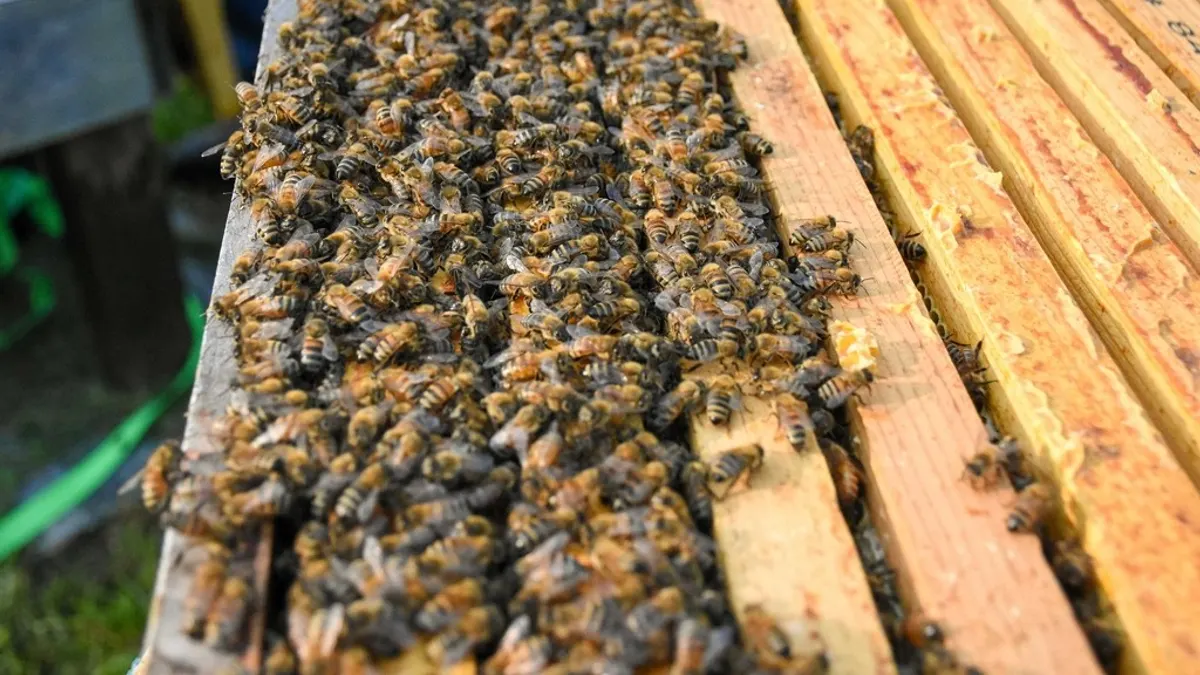
Cover photo: Honeybees crawl frames beehive North by U.S. Department of Agriculture, CC0 1.0, via rawpixel. Cropped.
Related guides
Beehive Wood and Coating Guide: Pine, Cedar, Beeswax Dip, Paint and Polystyrene
Beeswax dip, exterior latex, cedar and polystyrene compared from the suppliers' painting guides and extension sources, with what never gets painted.
Best Beehives for Beginners (2026): Langstroth Woodenware for a First Colony
Seven Langstroth hives for a first colony, compared on boxes and frames included, finish, dimensions and what the extension guides say a beginner needs.
Best Beekeeping Starter Kits of 2026: What Each Box Holds and What It Leaves Out
Six kits from Hoover, Honey Lake, Mann Lake, Dadant and Betterbee, compared on what is in the box, what is not, assembly and price.